

We publish the diagnoses.
That is the evidence base.
Every named pattern earns its place by being found in the wild—in public organisations, with the record to prove it.
The practice, working out loud.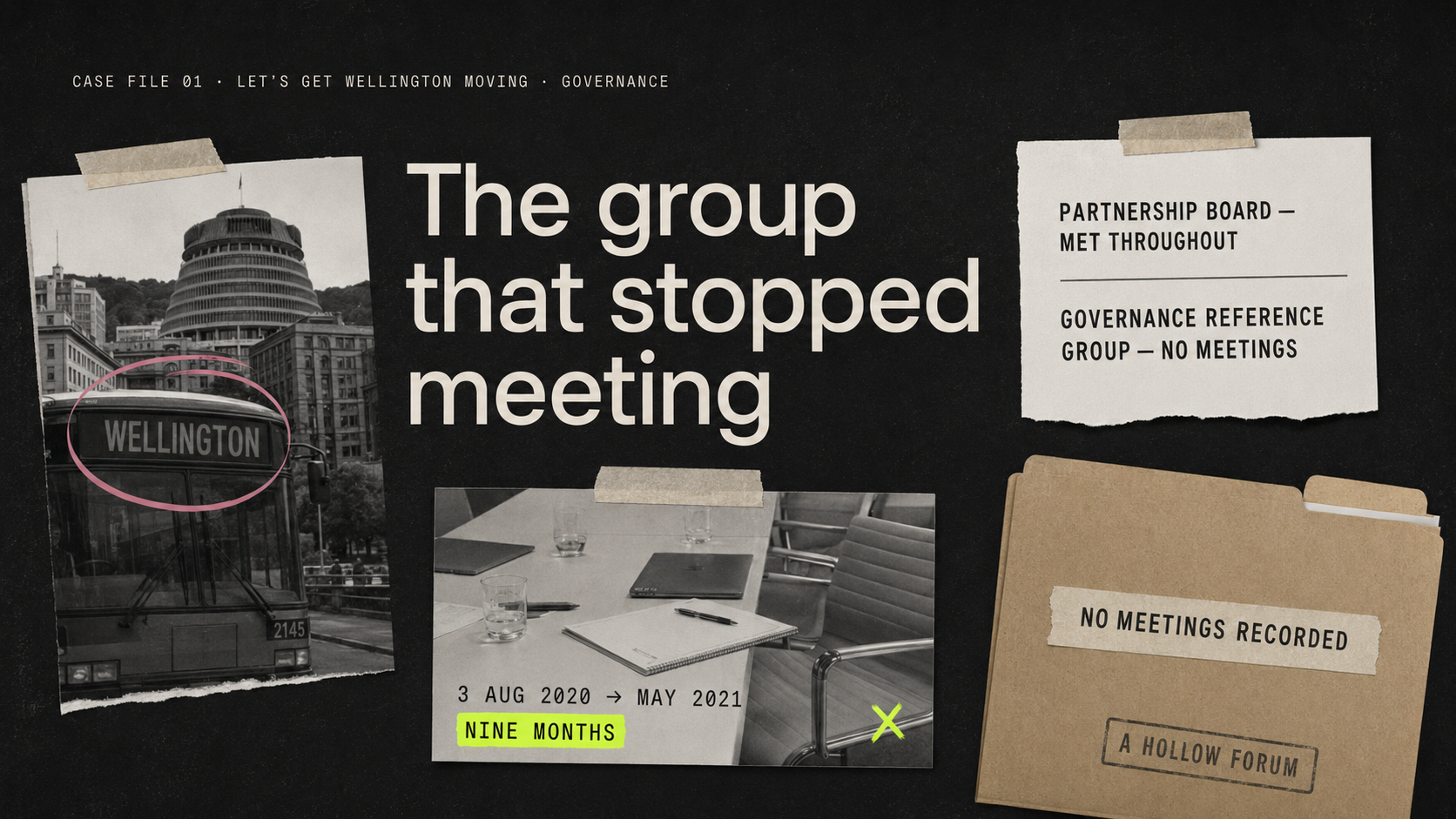
The group that stopped meeting
Documented organisational failures, examined through the public record. Dandylion names the patterns operating underneath them.
Let’s Get Wellington Moving was a $6.4 billion transport programme run by three partner organisations.
For nine months, the group created to help those organisations work through problems together did not meet.
During that same period, an independent health check found the programme was at risk of failing to deliver. It identified a “strategic leadership vacuum” and a partnership culture detrimental to collaborative and productive work.
The forum intended to hold the partnership together was absent while the partnership itself was identified as one of the programme’s central problems.
That is the case.
What happened to the Governance Reference Group?
Let’s Get Wellington Moving was a joint programme involving Wellington City Council, Greater Wellington Regional Council and Waka Kotahi.
Its governance structure included a Partnership Board, ultimately accountable for the programme, and a Governance Reference Group beneath it. The Reference Group was described as the “critical interface” between the three partner organisations: the place where problems crossing organisational boundaries could be worked through together.
The Reference Group met regularly until 3 August 2020.
Then it stopped.
It did not meet again until May 2021. The Partnership Board above it continued meeting throughout.
The nine-month gap became public in June 2021 after National MP Chris Bishop asked a written parliamentary question about the group’s meeting dates.
The defence
A governance group not meeting is not automatically evidence of failure.
Waka Kotahi said the Reference Group had “met as required”. During the gap, the programme was occupied with business-case work, an independent health check and its response to that review. The work continued; some of the coordination happened elsewhere.
That is a reasonable defence. A forum should not meet simply because a recurring invitation exists. If its work is being done more effectively somewhere else, not convening the formal group may be the sensible decision.
It also raises a harder question: if the forum was not required during one of the programme’s most difficult periods, what was it required for?
What the health check found
The Governance Reference Group did not go quiet during calm water.
The independent health check was undertaken during the gap and reported in December 2020. It found:
- the programme was at risk of failing to deliver;
- a strategic leadership vacuum;
- a partnership culture detrimental to collaborative and productive work;
- inadequate resourcing from the outset; and
- key roles vacant or filled temporarily.
Those findings concerned precisely the territory the Reference Group existed to hold: problems spanning the three partner organisations.
The defence explains what people were doing. It does not explain who was holding the partnership problem.
Technical work can continue without a functioning governance forum. Reports can be written. Business cases can advance. Individual organisations can keep making decisions at their own end.
That activity can make the absence harder to detect, because nothing stops completely. The programme continues moving—just without the mechanism intended to resolve what sits between the partners.
Who was responsible for noticing?
The Partnership Board was ultimately accountable, and it continued to meet.
The public record does not tell us whether the Board agreed to pause the Reference Group, sought assurance its function was being performed elsewhere, noticed the gap but did not consider it significant, or did not notice it at all.
We cannot turn an absent record into an accusation.
But we can identify what the structure made possible: a governance body could stop operating for nine months without its absence becoming a visible governance event.
It could not tell us whose alarm was meant to sound.
A Hollow Forum
A Hollow Forum
A formal group that remains present in the organisational structure after its operating function has weakened or disappeared.
It still has a name. Members. Terms of reference. A box on the governance diagram. What is missing is the live mechanism: decisions, challenge, coordination or escalation.
That distinction matters here. The programme did not stop. The technical work did not stop. The forum stopped.
Its continued existence on paper helped the governance structure retain its shape, even while one of its intended functions was absent.
The condition underneath it: Accountability Fog
Accountability Fog
Responsibility distributed across enough people, bodies and organisational layers that no single person clearly owns the moment when something has gone missing.
LGWM had an accountable Board, a Governance Reference Group, three partner organisations and multiple active workstreams. There was no shortage of governance language.
But governance language is not the same as a governance trigger.
When responsibility is spread across a system, every part of that system can reasonably believe another part is holding the issue. Nobody needs to abandon their job. Nobody needs to decide the forum no longer matters. The work simply migrates elsewhere, meeting by meeting, until the formal body is still there but its function is not.
The gap was eventually made visible to the public by someone outside the governance structure asking when the group had met. The record does not establish what was known internally before then. It does establish that the first clear public account came from outside.
A governance system does not become self-seeing because all its boxes are occupied.
How to recognise a Hollow Forum
- the group remains in governance documents, but its meeting rhythm has quietly changed;
- its work has migrated into projects, side conversations or smaller groups without a deliberate transfer of authority;
- reports still name the forum, but nobody can identify a recent decision it made;
- the body above it receives programme updates without checking whether the layer below is still functioning; or
- no named person is required to raise the alarm when the forum does not convene.
One cancelled meeting proves nothing.
Nine months tells you the system learned to operate around the absence.
Patterns and evidence
A Hollow Forum
A formal group that remains present in the structure after its operating function has weakened or disappeared.
Accountability Fog
Responsibility spread so broadly across people and structures that no one clearly owns the trigger for noticing failure.
- “Let’s Get Wellington Moving Governance Reference Group didn’t meet for nine months”, originally reported by the New Zealand Herald.
- Let’s Get Wellington Moving—Ministry of Transport, confirming the three programme partners and programme history.
- Wellington City Council Planning and Environment Committee agenda, 24 June 2021, recording that the health-check findings were received in December 2020.